Life
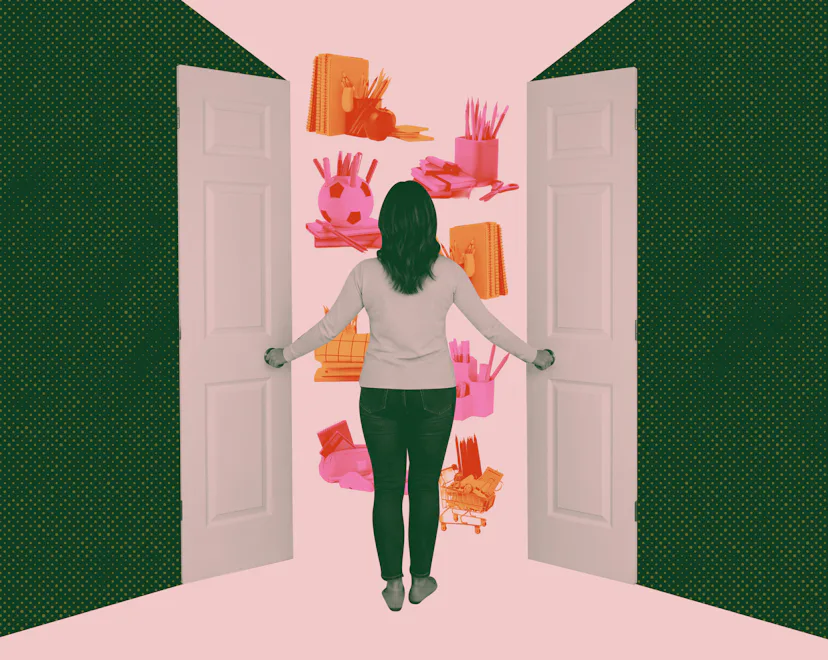
The Very Honest Reason I Shop My Own Closet For School Supplies
I realized, while I love back to school shopping, it was a completely unnecessary endeavor.
As a teacher and lifelong student, I share Kathleen Kelly from You’ve Got Mail’s love of a bouquet of newly sharpened pencils. I am seduced by back-to-school marketing: bright yellow banners with buses and apples and a smiling rainbow of crayons. I’m eager to trade our days of living by the light of the sun for the tick of a clock.
The beginning of school feels like the true New Year: I’m much more inspired to make resolutions as heat evaporates from the sidewalk than I do in the cold, mid-winter. Give me the schedules, the outcomes, the seating assignments! Give me some consistent childcare!
Any parent of young children knows that summer is hardly a vacation for the adults in the room. Last summer, with my kids home and hungry, I was fighting to reach inbox zero between sibling squabbles and second breakfast requests. While dishing out more bowls of berries, an email appeared: the back-to-school shopping list. Though the message was yet another task on my to-do list, it was a reminder that more care was around the corner. Someone other than me would be responsible for these children. Hallelujah!
With my nervous system activated from too much juggling, I jumped online to load the back-to-school list into my shopping cart. Crayons, scissors, folders — check, check, check! I purchased the items and waited for the boxes to appear on my doorstep.
Several days later, I attended to another task: clearing out the sheer amount of stuff that had accumulated in our home. As I sorted through broken toys and discarded craft supplies, I stumbled upon some other items: crayons, scissors, folders. All the items I'd bought so quickly online. All items that would be duplicated unnecessarily once my hastily purchased packages arrived.
I was aware of my consumer-stress cycle. The busier I became, the more likely I was to click “buy now.” When my schedule did not allow for an evening wind-down with a cup of tea and a good book, I’d find myself impulse buying after mindless doomscrolls. My response to the kids complaining of boredom (despite mounds of unfolded laundry, dirty dishes, and crumb-strewn floors) was to purchase a chore chart. Perhaps a dry-erase grid with tasks and magnetic check marks would finally produce some order in my home and discipline in my children.
These quick-hit purchases always ended similarly: initial interest followed by total disregard. I found chore chart magnets scattered throughout the recesses of our home. I bagged up my trendy Instagram purchases to drop off at Goodwill. No matter how many times I’ve tried to buy my way into sanity, I accomplished only the opposite: more clutter, more frustration, more wasted money. It was like setting dollar bills on fire.
Of course, I know I can’t simply buy my way into happiness. While I get a dopamine hit from shopping, I also experienced mental clarity and decreased anxiety as I cleared my clutter.
I longed to stop the pattern altogether: to boost my mood without accumulating more stuff, to live with the calm of knowing I had what I needed and not too much more. This year, I’m aiming to achieve these goals by revising my approach to back to school shopping. When I receive my kids’ supply list, before hopping immediately online, I want to take a beat to look around. Are there still glue sticks in the basement? Is that backpack from last year in pretty good shape? Do I really need a fancy new lunchbox, or could I rely on one of the many bags I have hanging out in the cupboard?
My kids can help with this assessment; no fancy chore chart required. Taking stock of our resources is an important lesson in home management and environmental prudence. As Bridget Shirvell writes in Parenting in a Climate Crisis, teaching kids to reduce waste is a way to help children learn to delay gratification and better care for our planet. Taking time to assess what is already available in our household economy helps us become better stewards of the earth.
Purchasing a box of pencils online may feel like a fresh start — but gathering all the scattered pencils from my supply closet, sharpening them, and placing them in a wiped-clean box is another form of renewal. What I truly long for, after all, is transformation — not disposability. No purchase required.
Anna Rollins is the author of Famished: On Food, Sex, and Growing Up as a Good Girl, a groundbreaking debut memoir that examines the rhyming scripts of diet culture and evangelical purity culture. Her writing has appeared in The New York Times, Slate, Electric Literature, Literary Hub, Joyland, and more. An award-winning instructor, she taught English in higher education for nearly 15 years and is a West Virginia Creative Network Literary Arts fellow. Follow her on Instagram and Substack @annajrollins
